Highlights
- Businesses share a hidden skeleton — Hay catalogs the entity structures (party, organization, product, agreement, activity, account) that recur under superficially different companies; the pattern density that makes model reuse — and ultimately generation — possible.
- Patterns are conventions of thought — the subtitle's claim: a modeling pattern is a shared mental structure that lets an analyst see the shape of a business faster than its own staff can; structure as a thinking tool, not just a documentation artifact.
- The generalization dial is the real design decision — Hay repeatedly shows one domain modeled at several abstraction levels and makes choosing the level the modeler's key judgment call; the exact trade-off every Data Vault ensemble and model-driven design negotiates.
- Even diagram layout deserves conventions — Hay argues models should be drawn to shared visual conventions so any trained reader can navigate any model; readability engineered through rules rather than left to individual style.
- The party/role pattern dissolves the customer-vendor-employee mess — separating who someone is from the roles they play is the single most reused pattern on this shelf, and it re-derives itself in every engagement.
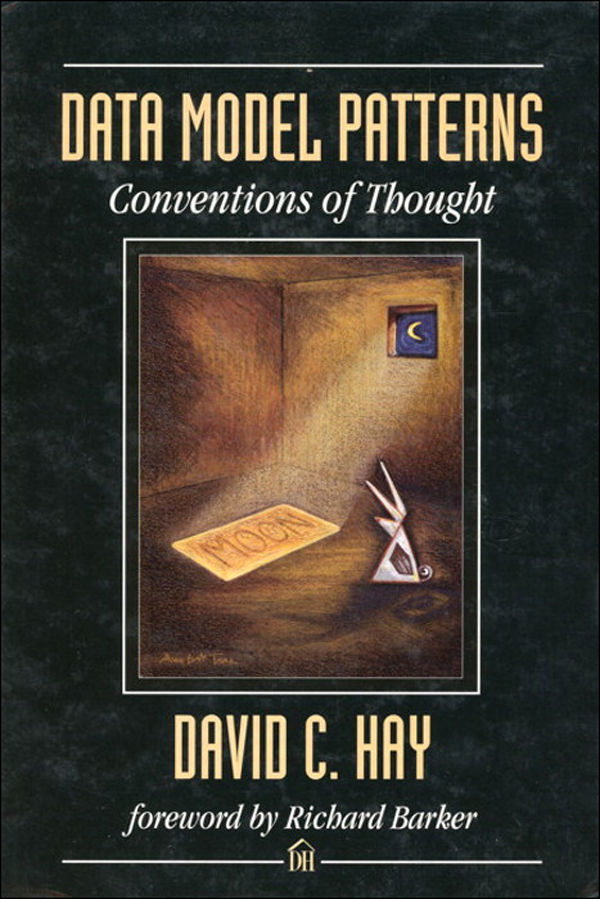
- This ebook is the same 1995 classic in a 2013 wrapper — duplicate edition of Data Model Patterns: Conventions of Thought (see that note for the full personal take); kept because the pattern catalog is the origin point of the MDDE lineage: Hay proved patterns exist, Data Vault standardized them, MDDE compiles them.
Highlights on this page are generated with the help of AI.