Why this is in my collection
From the publisher:
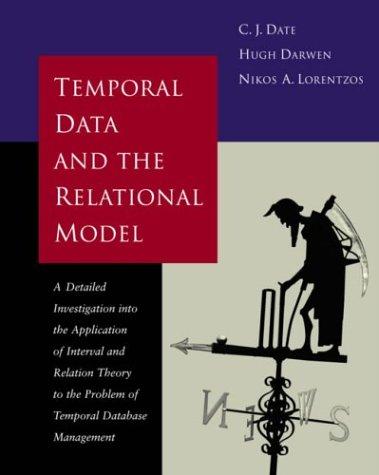
Temporal database systems are systems that provide special support for storing, querying, and updating historical and/or future data. Current DBMSs provide essentially no temporal features at all, but this situation is likely to change soon for a variety of reasons; in fact, temporal databases are virtually certain to become important sooner rather than later, in the commercial world as well as in academia. This book provides an in-depth description of the foundations and principles on which those temporal DBMSs will be built. These foundations and principles are firmly rooted in the relationa
Highlights
- Time as intervals, with proper operators — Date, Darwen and Lorentzos treat time periods as first-class values with interval algebra (including PACK/UNPACK to normalize overlapping ranges), giving temporal data the rigorous foundation that ad-hoc valid-from/valid-to columns never get.
- Temporal integrity must be stated as explicit constraints — no gaps, no overlaps, no contradictory concurrent versions: the book shows these are rules the model must declare and enforce, a textbook case of rules as the third pillar rather than an afterthought in ETL code.
- Extreme decomposition anticipates satellite thinking — splitting relations so each carries its own timeline (the 6NF direction) is the theoretical ancestor of Data Vault satellites and anchor modeling: history tracked per context, not per wide row.
- Valid time and transaction time are different questions — when something was true in the world versus when the database learned it; this separation is exactly what DV implements with load dates plus effectivity, and conflating the two corrupts both answers.
- The DBMS won't save you — written in 2003 on the premise that engines lack real temporal support, and two decades later that is still largely true: temporal correctness has to live in the model and its rules, which is why it survives platform churn.
- Foundations outlast features — the book derives everything from relational theory rather than any vendor's syntax; the payoff is that its reasoning still applies unchanged, a proof by longevity that the durable layer is the formal model.
Highlights on this page are generated with the help of AI.