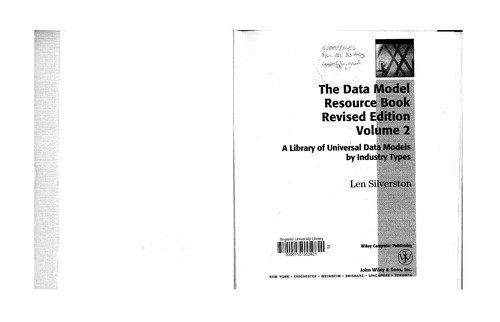
Why this is in my collection
From the publisher:
A quick and reliable way to build proven databases for core business functions Industry experts raved about The Data Model Resource Book when it was first published in March 1997 because it provided a simple, cost-effective way to design databases for core business functions. Len Silverston has now revised and updated the hugely successful First Edition, while adding a companion volume to take care of more specific requirements of different businesses. Each volume is accompanied by a CD-ROM, which is sold separately. Each CD-ROM provides powerful design templates discussed in the books in a re
Highlights
- Industry models are overlays, not replacements — Volume 2 layers vertical-specific structures (insurance, healthcare, manufacturing, telecom, finance) on top of Volume 1's universal core, a clean separation of the generic pattern from the specific variation that mirrors how MDDE splits reusable structure from domain rules.
- Comparing industries exposes the invariant backbone — reading the verticals side by side shows party, product, and agreement recurring everywhere while only the periphery changes; the invariants are what you can safely automate against.
- Variation itself is patterned — the differences between industries are not arbitrary but predictable extension points, which means even the customization layer can be treated as configuration rather than freehand modeling.
- Templates as delivery accelerators — starting an engagement from a published industry model collapses weeks of requirements archaeology into a review-and-adapt exercise, the modeling equivalent of scaffolding a pipeline instead of hand-coding it.
- A cross-industry pattern library validates business keys — the recurring core concepts per industry are a useful sanity check when identifying hubs and their business keys in a Data Vault: if the concept appears in Silverston's library, it is probably a real enterprise anchor, not a source-system artifact.
- Reference models teach modeling judgment — beyond reuse, studying dozens of worked models trains the eye for what good abstraction looks like; a curated corpus as a learning instrument, the same bet behind a concept library.
Highlights on this page are generated with the help of AI.