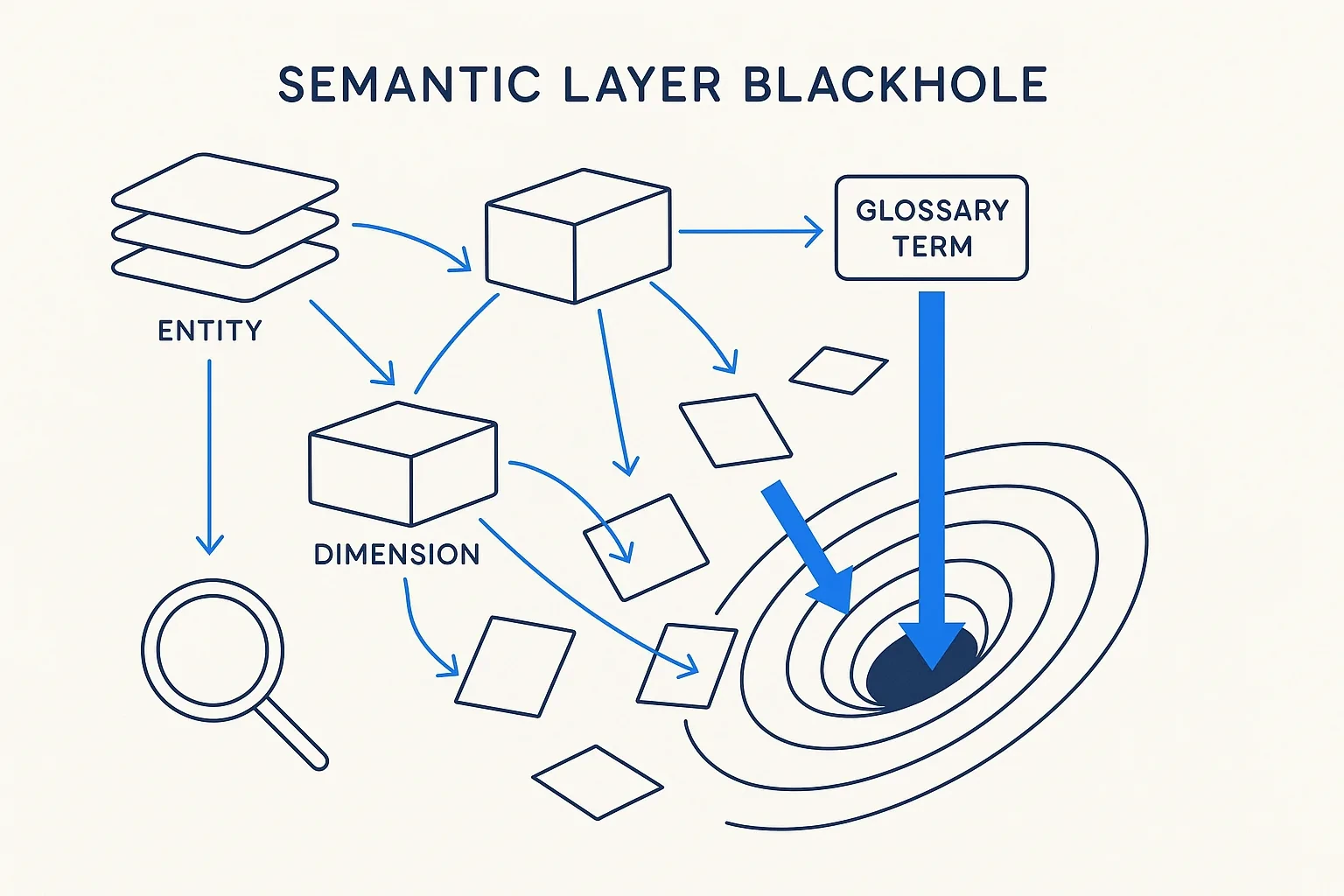
There are two ways a semantic layer dies, and they are opposites. Semantic drift is death by neglect: meaning erodes because no one governs it. The blackhole is death by accumulation: meaning is governed so thoroughly, so exhaustively, that the layer collapses under its own mass. Every entity, every dimension, every measure, every hierarchy, every glossary term, every access rule — each one added for a good reason, all of them together forming something no human can hold and no one dares prune. Past a certain weight it stops being a map of the business and becomes a second business to maintain. The mechanism is gravitational, which is why the metaphor fits. Each new definition pulls in the next: a metric needs a dimension, the dimension needs a hierarchy, the hierarchy needs a glossary entry, the entry needs an owner and an access rule. Nothing is wrong locally — every addition is defensible in isolation — but the layer's total mass grows faster than anyone's ability to reason across it. The tell is when people stop consulting the semantic layer and start rebuilding the definition they need in their own query, because finding the sanctioned one costs more than redefining it. At that point the layer has passed its event horizon: it still exists, it is still "governed", and it no longer governs anything. The trap is that the discipline which was supposed to prevent chaos becomes the thing that produces it. A team that has been burned by drift over-corrects toward completeness — model everything, define everything, govern everything — and mistakes volume for rigor. But a semantic layer's value is not proportional to how much it contains; it is proportional to how much of it people actually use and trust. A complete layer nobody can navigate is worth less than a small one everyone reaches for. The escape is not less governance but governed restraint: define only where meaning genuinely diverges from the obvious (you don't redefine every term, only the ones your business bends — the discipline of semantic design), start from the decisions that actually need it rather than from an urge to be exhaustive, and treat the layer's size as a cost to be justified, not a completeness score to be maximized. The question that keeps a semantic layer out of the blackhole is not "what else could we define?" but "what here has earned its place — and what is mass we are paying to carry?"
← All concepts & vocabulary